Latest Book :
Recent Books
View As:
Showing posts with label book I bought. Show all posts

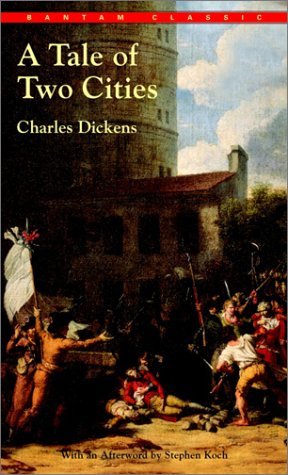
A Tale of Two Cities (1854)

A Tale of Two Cities (1854)
A Tale of Two Cities (1854) - A Tale of Two Cities. Charles Dickens. 1854/2003. Bantam Classics. 382 pages. [Source: Bought]

I didn't love A Tale of Two Cities. Or should I say I didn't love it as much as I hoped I would OR even thought I would. A Tale of Two Cities is definitely a subject-driven novel. The focus, I would even say sole focus, is on the French Revolution. We meet individual characters within that setting, to make the French Revolution more personal, perhaps, but, in my opinion, Dickens characterization is not as strong in A Tale of Two Cities as it is in some of his other novels. That doesn't mean his characters are not memorable. In fact, I imagine that there are at least two or three characters in this one that are very memorable indeed. A Tale of Two Cities is also a very heavy novel thematically. It's just dark and oppressive. Dickens won't be bringing any smiles to readers in this one. Personally, I love it when Dickens makes me laugh!

The novel begins with a reunion. A daughter, Lucie Manette, learns that the father she has long presumed to be dead is, in fact, alive. His existence seems to be news to quite a few people. Lucie Manette and Mr. Jarvis Lorry travel to France from England to meet him and bring him back. The name of this section is "Recalled to Life." And it's a very fitting title, in my opinion. Lorry and Lucie never really learn the whole story, all the ugly details of the past. Seeing Lucie with her father reminded me--in a good way--of the relationship between Jean Valjean and Cosette.

The second book, "The Golden Thread," introduces readers to Charles Darnay and Sydney Carton. These two men become very well known to Dr. Manette and his daughter. Both men love and admire her, as you would expect. But she can only love one of them, and, her heart belongs to Charles. Of course, this is a very simple summary!

The third book is "The Track of A Storm." Let's just say, Dickens can do bleakity-bleak. This book follows Charles Darnay into France during the early days of the French Revolution. I had a hard time reading this section, because I didn't want to experience it. Darnay is NOT alone in France. And he's far from forgotten. Dr. Manette and his daughter and granddaughter are there, for one, and so is Sydney Carton. Of course, there are others as well to round out the plot.

Throughout all three sections, readers have also followed a few people from France, mainly Monsieur Defarge and his not-so-lovely wife, Madame Defarge. I'm not sure I've ever hated a character more. I am sure that I have. Probably. Still, this book made me so very angry in places!!!

I won't talk about the ending. I won't. I don't want to. I probably don't even need to. A Tale of Two Cities left me needing a comfort read as a follow-up.

© 2014 A Tale of Two Cities (1854) of Collection of Book Reviews
Rate it :
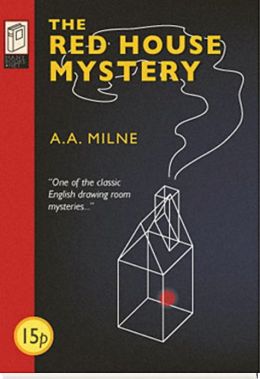
The Red House Mystery (1922)

The Red House Mystery (1922) - The Red House Mystery. A.A. Milne. 1922. Dover. 156 pages. [Source: Bought]

In the drowsy heat of the summer afternoon the Red House was taking its siesta. 

I loved The Red House Mystery. I did. It was so much fun! I loved meeting Antony Gillingham and his friend Bill Beverley. These two team up to solve a murder mystery. Bill Beverley is staying at the Red House estate--owned by Mark Ablett. He is one of a handful of guests. Antony Gillingham is not of the guests. Not originally. He just happens to be staying at an inn nearby. He hears from someone that Bill Beverley is down visiting. He wants to call on his friend and does so. But his visit does not go as expected. Instead of meeting Bill Beverley and having a lovely chat. He comes across Matthew Cayley--Mark's cousin he later learns--and a dead body! These two men are the first on the crime scene.

I would definitely recommend this one!

Quotes:
"Are you prepared to be the complete Watson?" he asked. "Watson?" "Do-you-follow-me-Watson; that one. Are you prepared to have quite obvious things explained to you, to ask futile questions, to give me chances of scoring off you, to make brilliant discoveries of your own two or three days after I have made them myself all that kind of thing? Because it all helps." "My dear Tony," said Bill delightedly, "need you ask?" Antony said nothing, and Bill went on happily to himself, "I perceive from the strawberry-mark on your shirt-front that you had strawberries for dessert. Holmes, you astonish me. Tut, tut, you know my methods. Where is the tobacco? The tobacco is in the Persian slipper. Can I leave my practice for a week? I can."
"I say," he said, almost pleadingly, "don't tell me that you can see into people's pockets and all that sort of thing as well." Antony laughed and denied it cheerfully. "Then how do you know?" "You're the perfect Watson, Bill. You take to it quite naturally. Properly speaking, I oughtn't to explain till the last chapter, but I always think that that's so unfair. So here goes. Of course, I don't really know that he's got it, but I do know that he had it. I know that when I came on him this afternoon, he had just locked the door and put the key in his pocket." 
"Good man," said Antony at the end of it. "You are the most perfect Watson that ever lived. Bill, my lad," he went on dramatically, rising and taking Bill's hand in both of his, "There is nothing that you and I could not accomplish together, if we gave our minds to it." "Silly old ass." "That's what you always say when I'm being serious. Well, anyway, thanks awfully. You really saved us this time."
"Of course it's very hampering being a detective, when you don't know anything about detecting, and when nobody knows that you're doing detection, and you can't have people up to cross-examine them, and you have neither the energy nor the means to make proper inquiries; and, in short, when you're doing the whole thing in a thoroughly amateur, haphazard way." 
© 2014 The Red House Mystery (1922) of Collection of Book Reviews
Rate it :

Dancers in Mourning (1937)

Dancers in Mourning (1937). Margery Allingham. 1937. 337 pages. [Source: Bought]
Dancers in Mourning (1937)
When Mr. William Faraday sat down to write his memoirs after fifty-eight years of blameless inactivity he found the work of inscribing the history of his life almost as tedious as living it had been and so, possessing a natural invention coupled with a gift for locating the easier path, he began to prevaricate a little upon the second page, working up to downright lying on the sixth and subsequent folios.
The book appeared at eighteen-and-sixpence, with frontispiece, in nineteen thirty-four and would have passed into the limbo of the remainder lists with thousands of its prototypes had not the quality of one of the wilder anecdotes in the chapters dealing with an India the author had never seen earned it a place in the news columns of a Sunday paper.
This paragraph called the memoirs to the attention of a critic who had not permitted his eminence to impair his appreciation of the absurd, and in the review which he afterwards wrote he pointed out that the work was pure fiction, not to say fantasy, and was incidentally one of the funniest books of the decade.
The public agreed with the critic and at the age of sixty-one William Faraday, author of Memoirs of an Old Buffer (republished at seven-and-six, seventy-fourth thousand), found himself a literary figure.
I was disappointed with this vintage mystery. While I absolutely loved the opening pages, by the end I found the whole book to be a mess. I admit it could be a mood thing. As much as I wanted to like it, even love it, perhaps I didn't have the patience to remember the large cast of suspects. Or perhaps the problem is that the characters aren't well drawn enough, aren't unique enough, to distinguish between. There were three or four characters that I could remember. But for the others, it was who is she again? who is he again? how does he fit into the group again? where did she come from?

Albert Campion has been invited into the inner circle of Jimmy Sutane and his friends. Sutane is in show business--the theater. Uncle William is, I believe, a mutual friend? Regardless, Uncle William is one of Campion's closest friends in the book. Anyway, Sutane invites Campion to his country house. There are many, many people there. Mostly his guests are in show business too--in the same currently running production. But a few are in his employ or in his family. By the end of the day, tragedy will strike and one of the guests will be dead.

The main reason I found this book to be a complete mess is Albert Campion. He is a horrible detective in this one. Why? Because at the party, he falls madly, deeply in LOVE with Jimmy Sutane's wife. He believes that they share a meaningful moment. In fact, he gets so swept up in the moment...he finds himself almost rushing across the room and taking her in his arms. At least he doesn't do that. But. Regardless. His inappropriate interest in Linda--Jimmy's wife--keeps him from using his brain for hundreds of pages. He doesn't want the murder to be solved just in case the murderer is someone that she cares about, just in case bringing the murderer to justice would make her feel bad. It's RIDICULOUS.

© 2014 Dancers in Mourning (1937) of Collection of Book Reviews
Rate it :

The Singing Sands (1952)

The Singing Sands (1952) - Josephine Tey. 1952. 224 pages. [Source: Bought]

It was six o'clock of a March morning, and still dark. The long train came sidling through the scattered lights of the yard, clicking gently over the points.

Inspector Alan Grant is on holiday. He's had to take a personal holiday because of his mental health condition. He's had a nervous break, I suppose. Suddenly, he's weighed down by fear and anxiety, and shame. He doesn't want everyone to know what his mind is doing to him. Little things that he's always taken for granted now are tormenting him: riding in a train, sleeping in a sleeper car, riding in a car, riding in a plane. He's become claustrophobic.
Well, at least he had managed not to open the door last night. But the triumph had been dearly bought. He was drained and empty, a walking nothingness. "Don't fight it," the doctor had said. "If you want to be in the open, go into the open." But to have opened the door last night would have meant a defeat so mortal that he felt there would be no recovery. It would have been an unconditional surrender to the forces of Unreason. So he had lain and sweated. And the door had stayed closed. (4)
The morning after his sleepless night, Grant discovers a dead body. "Number B Seven" is found dead in his sleeper. Grant, who is not on duty, gets a very good look at him, and he accidentally picks up the dead man's newspaper. He takes it with him by chance. Later, when he's arrived at his cousin's house, I believe, he realizes what he did. He notices for the first time that the paper had been written on. It contains a few lines of poetry. Grant isn't sure if the man was writing an original poem, or, if he was writing down someone else's poem. But either way, those lines and that handwriting make an impact on him. He can't stop thinking about "Number B Seven." Even though he's supposed to be on vacation, resting and relaxing, and FISHING.

As you have probably guessed, Grant is not going to do much relaxing on his vacation. Oh. He does try. But he keeps thinking about this case. A case that others at Scotland Yard have already closed. They've identified the body and the cause of death. End of story. But it's not enough for Grant. He thinks there is more to the story...and since this is his story, his FINAL story, I might add...he's right!

I liked this one. I am not sure I loved it. But I liked spending time with Grant.

© 2014 The Singing Sands (1952)  of Collection of Book Reviews
Rate it :
 
TOP
Copyright © 2014. a Books - All Rights Reserved Published By Kaizen Template | Cipto junaedy
Template Created by ThemeXpose